Clicker Training - Click into Calm
Building cooperation and confidence, one click at a time

Kamelia Miri
Sneak peek into the Article – Coming SOON
Clicker training is a powerful and versatile method of communication with animals. It can be used to teach new behaviours as well as modify existing behaviours while harbouring an enriching environment for both the trainers and their trainees.
A clicker is a small handheld device that makes a distinct clicking sound when pressed. The premise of clicker training is when an animal does the desired action, the guardian marks the precise moment the behaviour is performed by pressing the clicker; this is followed by presenting the animal with a reinforcer such as a treat. With repetition the animal pairs the sound of the click with a reinforcement he/she enjoys and is more likely to repeat the behaviour that resulted in the click in the future.
Clicker training is an extremely effective method of communication with an animal rooted in principles of respondent and operant conditioning. The sound of the clicker marks the exact moment a behaviour has taken place, without lag or ambiguity. Reinforcement in the form of treats, play, or any other activity that the animal enjoys is followed immediately after the sound of the clicker, consistently. This encourages the animal to repeat the behaviour in the future in order to hear the click and receive the reinforcement.
Conception and Evolution of Clicker Training:
Initially developed by Marian Breland Bailey and Keller Breland, students of the world renown psychologist, B.F. Skinner, in 1940s, gaining wide recognition in 1960s and 1970s in marine animal training including whales and dolphins. Clicker training was later expanded in effective training of other animals in zoos as well as working animals and house pets.
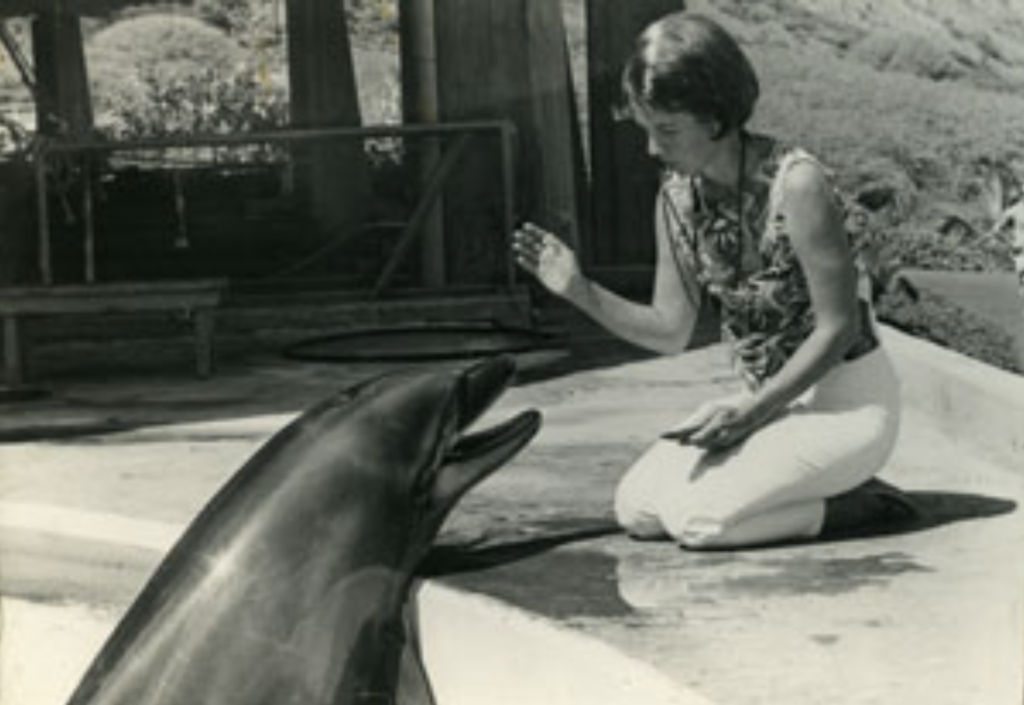
World renown animal trainer, Karon Pryor, cueing a dolphin at Sea Life Park in Hawaii (Image taken from: Karon Pryor Website)
Advancements in understanding Learning Theory principles, refinement of training techniques, and an expanding range of applications across different species and contexts has revolutionized Clicker training. Studies have shown accelerated learning across species catering to an environment free of stress and anxiety while enhancing the bond between the animal and his/her guardian
Clicker training relies on building strong associations between the sound of the clicker and positive reinforcement. Through shaping, targeting, and capturing, we guide dogs to learn new behaviours in small, achievable steps while keeping training precise and enjoyable
Association and Pairing
The first step in clicker training is teaching the dog that the sound of the click means something good is coming. Each click is immediately followed by a reward—like a treat or play. Over time, the dog learns that the click predicts reinforcement, making the sound itself powerful.
Shaping
Shaping is the process of rewarding small steps that lead toward the final behaviour. Instead of expecting the full action right away, we break it down into manageable pieces, clicking and rewarding progress along the way. This helps dogs learn complex behaviours without frustration.
Targeting
Targeting teaches the dog to touch or move toward a specific object, such as a hand, a stick, or a mat. It provides clear guidance, making it easier to direct the dog’s movements and build more advanced behaviours.
Capturing
Capturing means clicking and rewarding a behaviour the dog offers naturally, like sitting, lying down, or stretching. By reinforcing these spontaneous actions, we increase the likelihood the dog will repeat them when asked.